Will translation in Belgium
When dealing with the complexities of estate planning and inheritance, the clarity of legal documents is vital.
In a multilingual country like Belgium, where Dutch, French, and German are official languages, the need for a precise will translation or testament translation often arises during the settlement of an estate.
Whether you are an expatriate living in Brussels or a Belgian citizen with assets abroad, ensuring that your final wishes are accurately conveyed in the required administrative language is a legal necessity.
A last will translation is not merely a linguistic conversion; it is a legal adaptation that ensures the document maintains its validity and intent across different judicial systems.
Inheritance in Belgium
The process of inheritance in Belgium is governed by strict civil law principles.
When a person passes away, leaving a will written in a foreign language, or when a Belgian will needs to be presented to foreign authorities, the document must undergo a formal translation process.
This is where will translation services become indispensable.
Without a professionally translated document, heirs may face significant delays, increased costs, and potential legal disputes in the probate court.
High-quality translation ensures that every clause, from the appointment of executors to the distribution of specific legacies, is understood exactly as intended by the testator.
The legal translation sector in Belgium is continuously growing to meet the demands of international residents and cross-border legal requirements.
Choosing a specialised provider for your legal documents is the first step toward a smooth inheritance process.
Why is a certified will translation essential in Belgium?
In the eyes of the Belgian authorities, not all translations are created equal.
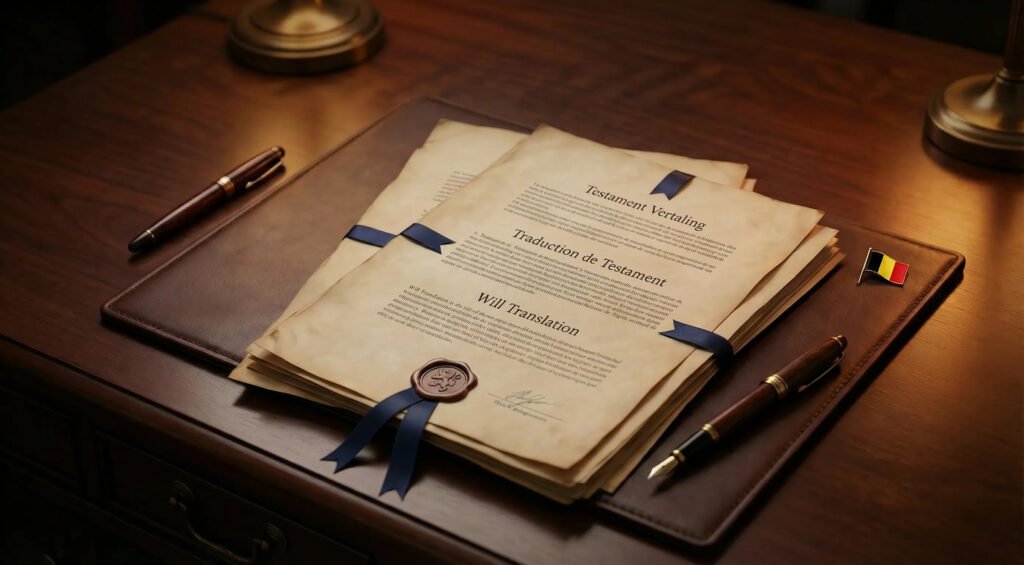
For a will to be recognised by a notary, a bank, or a court, it usually requires a certified will translation in Belgium.
A certified translation is performed by a sworn translator who has taken an oath before a Belgian court and is registered in the National Register of Sworn Translators and Interpreters (managed by the SPF Justice).
This certification provides a legal guarantee that the translation is a true and faithful representation of the original document.
When you seek a certified translation of a last will for probate court in Belgium, the translator appends a statement, their signature, and an official stamp to the document.
In many cases, especially for international use, this document may also require an electronic signature or a legalisation/apostille to verify the translator’s credentials.
This level of formality is essential because a single mistranslated word in a legal document can alter the distribution of an entire estate, leading to years of litigation among beneficiaries.
Learn more about certified translation services.
Professional will translation for Belgian inheritance
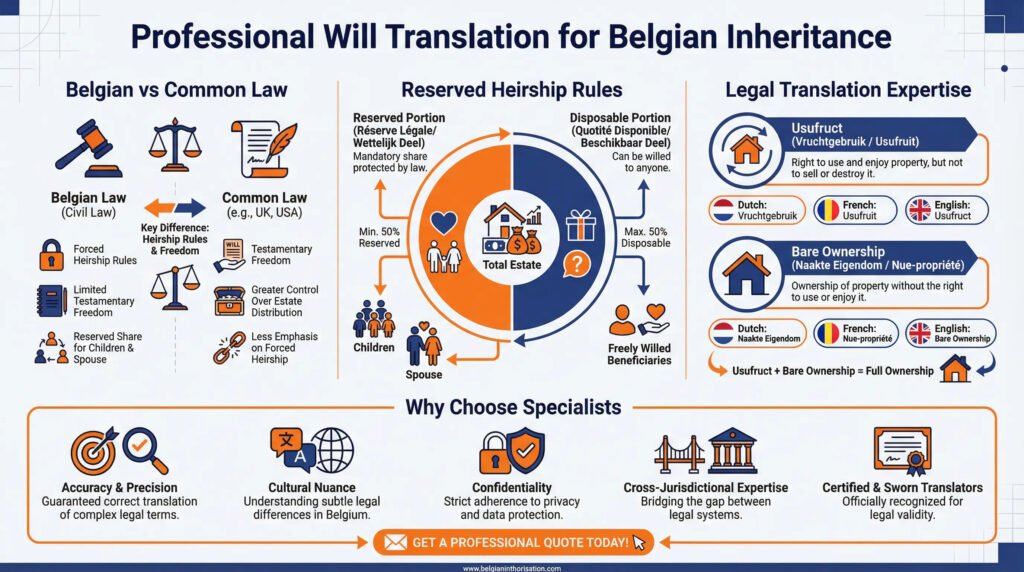
Inheritance laws (succession) in Belgium are distinct and can be quite different from those in common law jurisdictions like the UK or the USA.
For instance, Belgium has “reserved heirship” rules that dictate a minimum portion of the estate that must go to children or a spouse.
A professional will translation for Belgian inheritance must take these nuances into account.
A translator specialised in legal matters does not just translate words; they understand the underlying legal concepts.
For example, terms like “usufruct” (vruchtgebruik/usufruit) or “bare ownership” (naakte eigendom/nue-propriété) are common in Belgian estate law but might not have a direct equivalent in other languages.
A testament translation must accurately reflect these concepts so that a foreign notary or a Belgian judge can interpret the document correctly.
This expertise is why many law firms and private individuals rely on specialised agencies rather than generalist translators.
To ensure the best results, choose an agency with native-speaking legal experts and provide the translator with the full context of the document.
How to translate a last will from Dutch to French or English
Belgium’s linguistic borders often mean that a will drafted in Flanders (in Dutch) may need to be presented to a notary in Wallonia (in French) or to international banks (in English).
To translate a last will from Dutch to French or English, the translator must be fluent in the legal terminology of both the source and target systems.
Dutch legal terminology in Belgium (Belgisch-Nederlands) can differ significantly from the Dutch used in the Netherlands, adding another layer of complexity to the task.
When moving between the national languages of Belgium, the translation must adhere to the specific legal jargon used in the Belgian Civil Code.
If the document is intended for use in the UK or the US, the translator must find the closest equivalent in common law to ensure the last will translation is actionable by foreign executors.
This cross-border expertise is a hallmark of high-end testament translation services.
View all available language combinations.
The role of notarised will translation in Belgium
While “certified” and “notarised” are sometimes used interchangeably in common parlance, they have specific meanings in the Belgian context.
A notarised will translation in Belgium often refers to a translation that has been certified by a sworn translator and then had the translator’s signature authenticated by a notary or the Ministry of Justice.
This is frequently required when the will is being sent abroad to a country that is not part of certain international treaties, or when a specific foreign institution demands a higher level of verification.
A notary plays a central role in Belgian inheritance.
They are responsible for searching the National Register of Wills (CRT) and overseeing the liquidation of the estate.
If you are presenting a foreign document, the notary will likely insist on a notarised will translation to ensure they are fulfilling their professional liability.
This process ensures that the will translation carries the same weight as the original document in the eyes of the law.
Testament translation services for cross-border estates
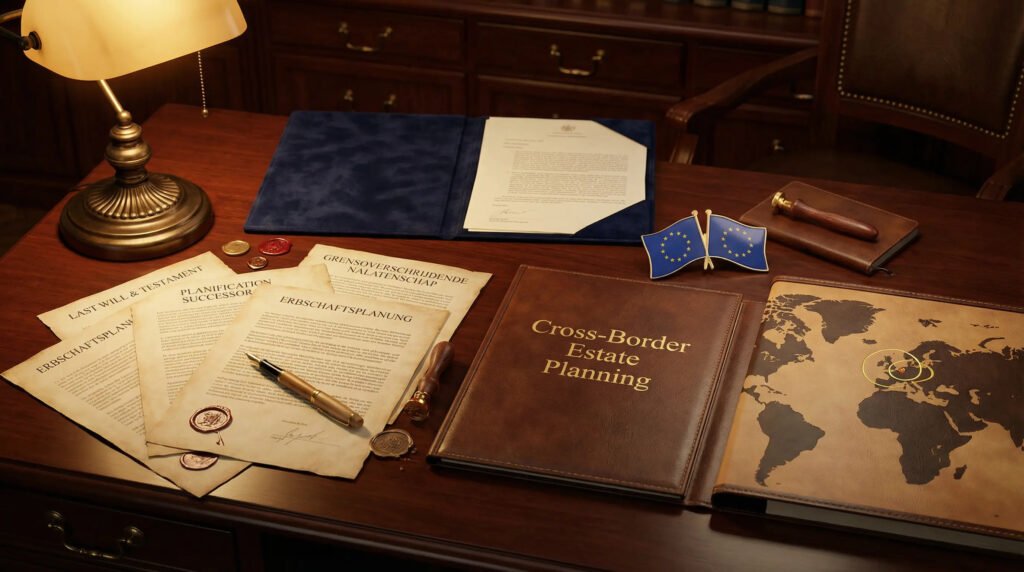
The rise of global mobility has led to an increase in “cross-border estates,” where a deceased person may have owned property in multiple countries.
In these scenarios, testament translation services for cross-border estates are vital.
Dealing with the “European Succession Regulation” (Regulation EU No 650/2012) requires a clear understanding of which country’s law applies to the succession.
A last will translation helps clarify the “habitual residence” and any “choice of law” clauses that the testator may have included.
For families managing assets in both Belgium and abroad, the administrative burden can be overwhelming.
Coordinating between different legal systems requires precision.
Choosing the right translation partner acts as a bridge between different cultures and legal frameworks, ensuring that nothing is lost in translation.
How to translate a foreign will for a Belgian notary
If you have a will drafted in the United States, Canada, or any other foreign country, and you need to settle an inheritance involving Belgian property, you will need to know how to translate a foreign will for a Belgian notary.
The first step is usually obtaining an original or a certified copy of the will from the home country, often with an Apostille attached.
Once the document is in Belgium, you must contact a sworn translator for a certified will translation in Belgium.
The notary will use this translation to draft the “Acte d’Hérédité” (Certificate of Inheritance) or the “Déclaration de Succession” (Inheritance Tax Return).
It is important to note that Belgian tax authorities (Vlabel in Flanders, or the SPW in Wallonia) are very strict about deadlines.
Delays in will translation can lead to late-filing penalties, making it imperative to start the translation process as soon as possible.
Where to translate a will for inheritance proceedings in Brussels
Brussels, as the heart of Europe, is home to a vast international community.
Consequently, the demand for legal translations is high.
If you are looking for where to translate a will for inheritance proceedings in Brussels, you should look for agencies that specialise in legal and sworn translations.
While there are many individual translators, an agency often provides the benefit of project management, ensuring that the document is not only translated but also proofread and formatted correctly.
In Brussels, the courts and administrative bodies require documents to be in one of the national languages.
If your will is in English, Spanish, or Italian, a testament translation into French or Dutch is mandatory for it to have any legal effect.
Professional agencies in the capital are well-versed in the requirements of the Brussels courts and can often expedite the process for urgent probate matters.
The risks of unprofessional will translation
It can be tempting to use automated tools or an uncertified translator to save on costs.
However, in the realm of will translation, the stakes are too high.
Legal language is “performative”; the words themselves create legal obligations and rights.
A mistake in a last will translation could lead to:
- Invalidation of the document: if the translation does not meet the formal requirements of the Belgian court, it may be rejected entirely.
- Incorrect asset distribution: misinterpreting a technical term could result in the wrong person receiving an inheritance.
- Tax issues: Inheritance tax in Belgium is calculated based on the relationship between the deceased and the heir. A translation error regarding the nature of the relationship could lead to incorrect tax assessments.
- Lengthy delays: if a notary or the probate court finds inconsistencies in the testament translation, they will require a new version, stalling the entire estate settlement.
For these reasons, investing in professional will translation for Belgian inheritance is a protective measure for your family’s future and your own peace of mind.
Safeguard your legacy with professional translation
A will translation is one of the most important legal documents you may ever need.
Whether you require a certified will translation in Belgium for local proceedings or testament translation services for cross-border estates, working with qualified professionals ensures that your final wishes are honoured exactly as intended.
Do not leave your family’s future to chance.
By choosing a specialised agency, you protect your legacy and provide your loved ones with clarity during a difficult time.
Ready to get started?
Request a free quote today or contact BeTranslated at +32 485 85 30 89 or hello@betranslated.be.
Request a Free QuoteFrequently asked questions
What is a sworn translation of a will?
A sworn translation (or certified translation) is a document translated by a professional who has been officially recognised by the Belgian judicial system.
In Belgium, this means the translator is listed in the National Register of Sworn Translators.
This type of will translation is required for all official purposes, such as presenting a foreign will to a Belgian notary or court.
How long does it take to translate a last will in Belgium?
The timeframe for a testament translation depends on the length and complexity of the document, as well as the language pair.
Generally, a standard will can be translated and certified within 3 to 5 business days.
However, if additional legalisation or an apostille is required for international use, the process may take longer.
It is always best to plan to meet strict inheritance tax filing deadlines.
Can I translate my own will for legal use in Belgium?
No.
Even if you are fluent in both languages, a last will translation for official use must be performed by an independent, sworn translator.
Belgian authorities require a third-party certification to ensure the translation is unbiased and accurate.
Self-translated documents will not be accepted by notaries or the probate court.
Does a translated will need an Apostille?
Whether a will translation needs an Apostille depends on the country where the document was issued and where it will be used.
For a foreign will being used in Belgium, the original document often needs an Apostille from its country of origin.
The translation itself may also need an Apostille if it is being sent from Belgium to another country.
Your translation agency or notary can advise you on the specific requirements for your situation.
How much does professional testament translation cost?
The cost of testament translation services varies based on word count, the rarity of the language pair, and the urgency of the request.
Certified translations also carry a certification fee.
While it may be more expensive than a standard translation, the cost is a fraction of the potential legal fees that could arise from an inaccurate or uncertified translation.
Most agencies provide a free quote based on a scan of the document.
View translation rates for more information.