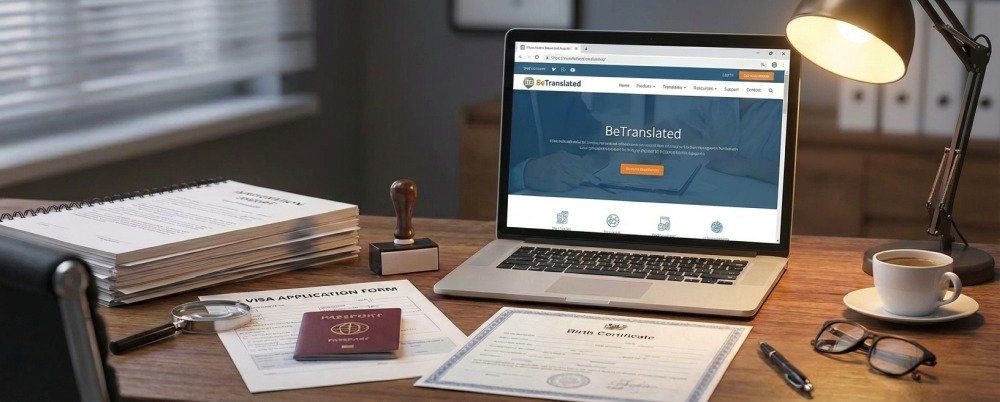
Why does inheritance document translation matter in Belgium
Managing the affairs of a deceased loved one is an emotionally taxing and legally complex process.
When an estate involves assets or beneficiaries across international borders, the complexity multiplies.
In a multilingual nation like Belgium, where Dutch, French, and German are official languages, inheritance document translation becomes a critical step in the legal process.
Whether you are dealing with a local notary or an international probate court, ensuring that every document is accurately translated is essential for a smooth transition of assets.
Belgium’s unique position in Europe often leads to “cross-border successions.”
This occurs when a person dies in Belgium holding assets abroad, or when a foreign resident leaves property within Belgian territory.
In these scenarios, estate document translation is not just a convenience; it is a legal requirement.
| Key Point | What It Means (in plain English) |
|---|---|
| Authorities need exact, often certified documents | Notaries, banks, and tax authorities (e.g., SPF Finances) typically require precise, sometimes certified, legal paperwork to confirm claims and release funds. |
| Probate translation is not “word-for-word” | The process involves more than swapping words between languages—accuracy, context, and legal meaning are essential. |
| Legal-system knowledge is required | A translator must understand the legal frameworks on both sides to ensure the translation matches how the documents will be interpreted and accepted. |
| “Probate” doesn’t map neatly to Belgian civil law | “Probate” exists in common law systems (UK/US), but it has no direct equivalent in the Belgian civil law framework—so the concept must be translated carefully, not just the term. |
Navigating these terminological nuances is why the legal translation market in Belgium remains a vital sector for international families and legal professionals alike.
Why do you need professional inheritance document translation in Belgium?
Belgium is a federal state with three distinct linguistic communities.
Consequently, an inheritance file translation in Belgium is frequently required even for domestic cases.
For example, a resident in Flanders may own property in Wallonia, necessitating a need to translate inheritance papers from Dutch to French to satisfy the requirements of a local notary or registration office.
Without professional inheritance document translation, the legal validity of the documents may be questioned, leading to costly delays in the liquidation of the estate.
When dealing with succession document translation services, accuracy is paramount.
A single mistranslated clause in a will or a misinterpreted term in a marriage contract can alter the distribution of assets, potentially leading to family disputes or legal challenges.
Professional translators specialising in law understand the specific “legalese” used in Belgian “Actes de Succession” (Deeds of Succession) and “Déclarations de Succession” (Inheritance Tax Returns).
Furthermore, certified estate document translation is often mandatory.
In Belgium, a “traduction jurée” (sworn translation) is performed by a translator who has taken an oath before a court.
These translators are registered in the National Register of Sworn Translators and Interpreters.
Their stamp and signature provide the official recognition needed by Belgian authorities to accept foreign documents as evidence in inheritance proceedings.
The role of the notary in Belgian succession
In Belgium, the notary is the central figure in any inheritance matter.
They are responsible for identifying heirs, determining the composition of the estate, and ensuring that inheritance taxes are paid.
If you are wondering how to translate inheritance documents for a Belgian notary, the answer usually involves hiring a specialised agency that provides sworn translations.
The notary will often require the original foreign document accompanied by its certified translation to draft the “Acte d’Hérédité” (Certificate of Inheritance).

Key documents requiring professional inheritance document translation for Belgian succession
The paperwork involved in a succession is extensive.
Depending on the complexity of the family tree and the nature of the assets, professional inheritance document translation for Belgian succession may be required for a variety of files.
These typically include:
- Wills and codicils: the foundational documents expressing the deceased’s last wishes.
- Death certificates: necessary to officially open the succession file.
- Marriage contracts and divorce decrees: these determine the matrimonial regime and the surviving spouse’s rights.
- Certificates of inheritance (Actes d’Hérédité): documents proving who the legal heirs are.
- Life insurance policies: involving beneficiaries in different countries.
- Property deeds and valuation reports: essential for calculating inheritance tax on real estate.
- Bank statements and investment portfolios: for the declaration of movable assets.
For those managing an estate from abroad, probate document translation services in Belgium and internationally ensure that all these documents meet the formal requirements of the destination country.
For instance, a Belgian “Déclaration de Succession” might need to be translated into English for the UK’s HM Revenue and Customs if the deceased held British assets.
The answer lies in choosing an agency that employs native-speaking legal experts.
Certified translation of estate files for cross-border inheritance
In the era of global mobility, it is common for individuals to live and work in multiple countries.
This leads to the need for certified translation of estate files for cross-border inheritance.
When a foreign national dies in Belgium, their heirs—who may reside elsewhere—must navigate the Belgian legal system.
This is where inheritance file translation for foreign beneficiaries in Belgium becomes indispensable.
The European Succession Regulation (EU No. 650/2012) was designed to simplify cross-border successions within the EU.
It introduced the European Certificate of Succession (ECS).
However, even with the ECS, translations are frequently required if the document is issued in a language other than the official language of the member state where it is being used.
A certified estate document translation ensures that the ECS is recognised by banks and land registries in Belgium, France, Germany, or any other EU country.
How to choose the best inheritance document translation services
Selecting the right partner for your succession translation needs is a decision that impacts the speed and legality of your inheritance process.
When looking for succession document translation services, consider the following factors:
1. Legal expertise and specialisation
Legal translation is a niche field.
The translator must be familiar with the Civil Code (in Belgium) or Common Law (in the UK/US).
They should understand the specific terminology related to “usufruit” (usufruct), “nue-propriété” (bare ownership), and “quotité disponible” (available portion).
2. Sworn and certified status
As mentioned, most Belgian authorities will only accept translations performed by a sworn translator.
Ensure the agency you choose has access to translators registered with the Belgian Ministry of Justice.
This is vital for certified estate document translation.
3. Confidentiality and security
Inheritance documents contain highly sensitive personal and financial information.
A professional agency will have strict data protection protocols in place to ensure your inheritance file translation in Belgium remains private.
4. Understanding costs
Legal translations are generally priced higher than general translations due to the expertise required.
If you are concerned about the budget, it is helpful to research translation rates to understand how costs are calculated based on word count, technicality, and urgency.
The process of translating inheritance papers from Dutch to French
Within Belgium, the most frequent request is to translate inheritance papers from Dutch to French or vice versa.
This often happens when a deceased person lived in Flanders but had heirs in Wallonia or Brussels, or when the notary handling the estate operates in a different linguistic region.
| Step | Description |
|---|---|
| Initial Assessment | The client provides digital copies of the documents, and the translation agency evaluates the volume of work and whether certification will be required. |
| Translation by a Legal Specialist | A native speaker of the target language with legal training completes the translation to ensure legal accuracy and appropriate terminology. |
| Revision and Proofreading | A second linguist reviews the translated text to verify accuracy, completeness, and consistency with the original legal terminology. |
| Certification (If Required) | The sworn translator signs and stamps the translated document and may attach a copy of the original for official validation. |
| Delivery | The finalized documents are delivered to the client or sent directly to the notary or relevant authority. |
For inheritance file translation for foreign beneficiaries in Belgium, this process may also include obtaining an “Apostille” if the document is destined for a country outside the EU.
An Apostille is an international certification that authenticates the signature of the sworn translator for use in foreign jurisdictions.
Learn more about delivery times.
Probate document translation services in Belgium and internationally
The reach of probate document translation services in Belgium and internationally extends beyond the borders of Europe.
With many Belgians moving to North America, the Middle East, or Asia, the demand for English, Spanish, and Arabic translations of estate files has grown significantly.
International probate often involves “Letters of Administration” or “Grants of Probate.”
When these documents arrive in Belgium, they must undergo a rigorous inheritance document translation process to be recognised by the Belgian court system.
Conversely, Belgian “Actes de Notoriété” must be translated into English for use in New York or London.
In these cases, professional inheritance document translation for Belgian succession acts as the bridge between two very different legal worlds.
View all available language combinations.
Secure your legacy through professional translation
Managing an inheritance is a responsibility that requires precision, patience, and professional support.
Whether you need to translate inheritance papers from Dutch to French for a local administrative task or require probate translation for a complex international estate, the quality of your translated documents is paramount.
By opting for professional inheritance document translation for Belgian succession, you ensure that the wishes of the deceased are respected and that the rights of the beneficiaries are protected.
In the multilingual landscape of Belgium, clear communication is the key to resolving succession matters efficiently and without legal friction.
Trusting expert succession document translation services is an investment in peace of mind during a difficult time.
Ready to get started?
Request a free quote today or contact BeTranslated at +32 485 85 30 89 or hello@betranslated.be.
Frequently asked questions
What is the difference between a standard translation and a sworn translation for inheritance?
A standard translation is for informational purposes only.
A sworn translation (traduction jurée) is performed by a translator recognised by the Belgian courts.
It includes the translator’s signature and stamp, making it a legally valid document that can be accepted by notaries, banks, and government agencies for inheritance document translation.
How long does it take to translate an inheritance file in Belgium?
The timeline depends on the volume of documents.
A single death certificate or will might take 2-3 business days.
A full inheritance file translation in Belgium, including property deeds and bank statements, may take a week or more.
It is always best to provide the documents as early as possible to meet tax filing deadlines.
Do I need to translate my foreign will to use it in Belgium?
Yes.
If you have a will written in a language other than the official language of the Belgian region where the succession is opened (Dutch, French, or German), a certified estate document translation will be required by the notary to process the estate and by the tax authorities to calculate inheritance duties.
Can one agency handle both the translation and the legalisation (Apostille)?
Many professional succession document translation services can assist with the legalisation process.
While the Apostille itself is issued by the Ministry of Foreign Affairs, the translation agency can handle the coordination and ensure the sworn translator’s signature is on file for authentication.
Is probate translation only for English-speaking countries?
No.
While “probate” is a term primarily used in English-speaking common law jurisdictions, probate translation is a general term used in the industry to describe the translation of any legal documents related to the administration of a deceased person’s estate, regardless of the language involved.