
The critical role of healthcare interpreting services in Belgium
In clinical settings, language barriers aren’t logistical; they’re life-threatening.
Miscommunication in Belgian hospitals can lead to misdiagnosis, medication errors, and violations of the Belgian Patient Rights Act (2002) and GDPR Article 9 on health data.
Belgium’s trilingual reality, Dutch (Flanders), French (Wallonia), and German (Eupen), plus its status as the EU’s administrative capital, means clinics in Brussels, Antwerp, Liège, and Ghent routinely treat patients with limited language proficiency (LLP).
Relying on family members or untrained bilingual staff introduces unacceptable clinical and legal risk.
Professional healthcare interpreting services in Belgium are not optional; they’re a duty of care.
The lethal cost of informal interpreting
Using a child to interpret a cancer diagnosis in Brussels or asking a receptionist to translate dosage instructions in Ghent breaches medical ethics and Belgian law.
Risks include:
- Clinical harm: Mistranslation of symptoms like “chest tightness” vs. “indigestion” can delay critical intervention.
- Invalid consent: Uninformed consent due to poor interpretation voids legal validity under SPF Justice oversight.
- Data breaches: Family interpreters aren’t bound by GDPR or professional secrecy (secret professionnel).
- Malpractice exposure: The cost of one lawsuit dwarfs years of professional interpreting fees.
What defines a qualified healthcare interpreter in Belgium?
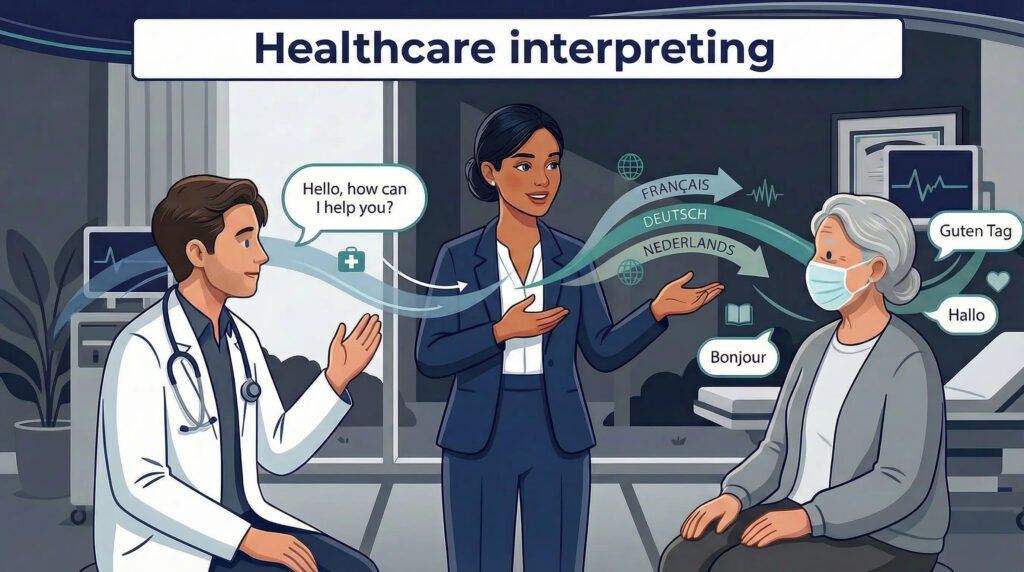
Professional healthcare interpreting in Belgium must combine linguistic precision, cultural fluency, and clinical knowledge.
Key credentials include:
- Medical terminology mastery: Oncology, cardiology, psychiatry, across Dutch, French, and German variants.
- Impartiality: No softening of bad news; strict adherence to verbatim relay.
- Legal compliance: Many hold certifications recognised by the SPF Justice or equivalent to the UK’s DPSI (Diploma in Public Service Interpreting).
- Cultural competence: Understanding how Flemish patients describe pain versus Walloon norms affects diagnostic accuracy.
Modes of delivery for modern clinical workflows
BeTranslated supports all modalities to match urgency and setting:
| On-site interpreting | Video Remote Interpreting (VRI) | Over-the-Phone Interpreting (OPI) |
| For surgeries, psychiatric evaluations, or complex consultations in Brussels or Antwerp | Secure, real-time support for telehealth or rural clinics | Emergency access to certified linguists in under 3 minutes |
Regulatory compliance: UK & Belgian requirements
For UK providers: The Care Quality Commission (CQC) and NHS England’s Accessible Information Standard mandate qualified interpreters for patients with limited English proficiency (LEP).
Non-compliance risks, “Inadequate” ratings and Equality Act 2010 claims.
For Belgian providers: The Patient Rights Act guarantees patients the right to “clear, comprehensible information” in their language.
Failure to provide this is a reportable breach to regional health inspectorates.
Why BeTranslated? Trusted by Belgian healthcare institutions
With 20+ years in the Benelux market, BeTranslated delivers:
- A vetted network of DBS-checked (UK) and Extrait de Casier Judiciaire-screened (BE) interpreters.
- 98.7% first-time acceptance rate for official medical documents submitted to Belgian authorities.
- Local presence in Liège and Brussels with deep integration into Flanders’ and Wallonia’s healthcare ecosystems.
- GDPR-compliant workflows and ISO-certified data handling.
We serve hospitals, private clinics, and NHS trusts with professional healthcare interpreting services, coordinating cross-border care, and ensuring every patient receives equitable, safe, and legally compliant care.
Act now: Protect patients and your institution
Don’t wait for an incident. Audit your current language access protocol today.
Frequently asked questions
Why can’t we use a patient’s family member?
Family members lack medical vocabulary, may omit sensitive details, and aren’t bound by confidentiality.
Children’s interpretation violates child protection principles and invalidates informed consent.
What’s the difference between a bilingual staff member and a professional interpreter?
Bilingualism ≠ interpreting skill.
Only trained interpreters master clinical terminology, ethical neutrality, and techniques like consecutive or simultaneous relay required in high-stakes settings.
How is patient confidentiality ensured?
All interpreters sign GDPR-compliant NDAs and adhere to Belgium’s secret professionnel.
Many are registered with SPF Justice, requiring clean criminal records.
Are your interpreters qualified?
Yes. Our linguists hold DPSI, Master’s in Conference Interpreting, or Belgian-equivalent credentials, with specialisation in medical domains.
How fast can you deploy an interpreter?
OPI: under 3 minutes. On-site in Brussels/Antwerp: same-day. VRI: immediate scheduling.