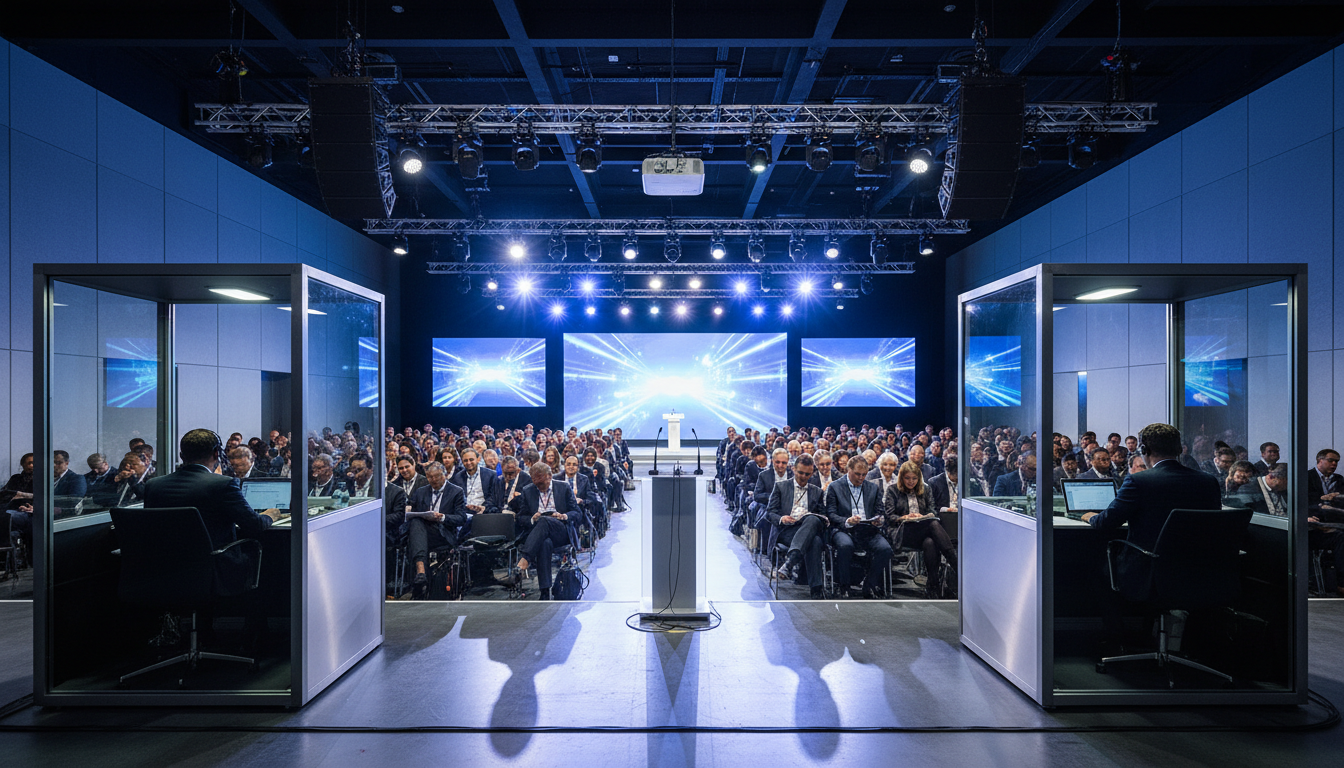
Court interpreting in Belgium: Ensuring access to justice across language barriers
Accurate communication determines case outcomes in Belgian courtrooms.
A single misinterpreted statement during criminal hearings in Antwerp or commercial disputes in Brussels may trigger procedural nullity.
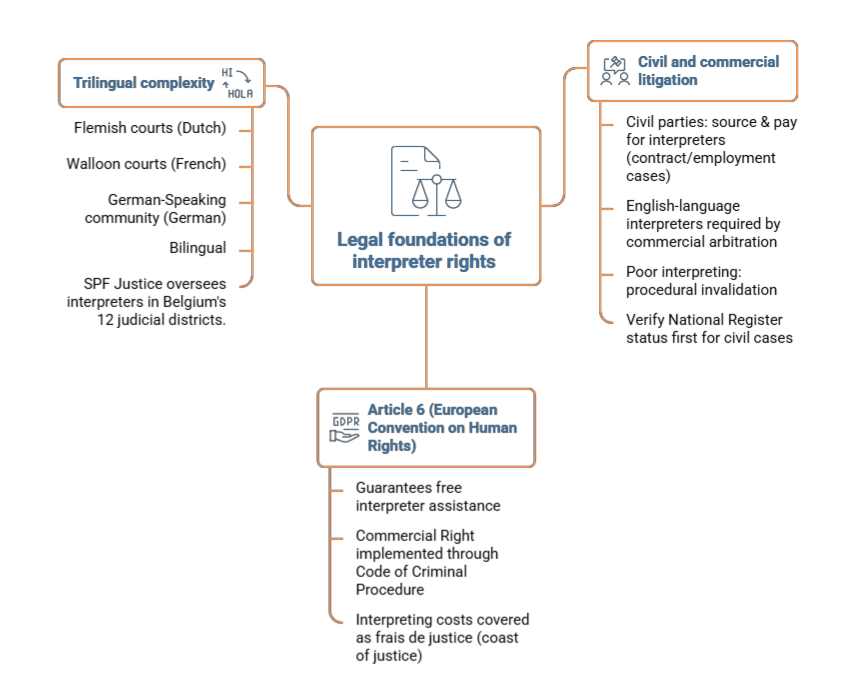
Belgium recognises Dutch, French, and German as official languages under its constitutional framework.
English is often used as a working language in international litigation involving EU institutions.
To guarantee quality and legal validity, the SPF Justice maintains the National Register of Sworn Translators and Interpreters, ensuring that only qualified professionals support judicial proceedings.
Sworn interpreters are trained in Belgian civil, criminal, and administrative procedures and play a key role in cases involving immigration, corporate disputes, and family law.
Only interpreters registered in the national database are authorised to provide legally valid interpreting services during official proceedings.
Legal foundations: The right to court interpreting in Belgium
Qualifications and responsibilities of sworn interpreters
National Register requirements
To be considered for court interpreting in Belgium, inclusion in Belgium’s National Register requires passing rigorous examinations administered by the SPF Justice:
- Linguistic competence: near-native mastery of working languages verified through examination.
- Legal knowledge: demonstrated understanding of Belgian judicial procedures, including distinctions between civil, criminal, and administrative processes.
- Professional experience: documented track record in translation or interpreting.
- Clean criminal record: provision of an extrait de casier judiciaire confirming suitability for justice system work.
- Formal oath: sworn before the President of the Court of First Instance, committing to honesty and accuracy.
Ethical obligations during proceedings
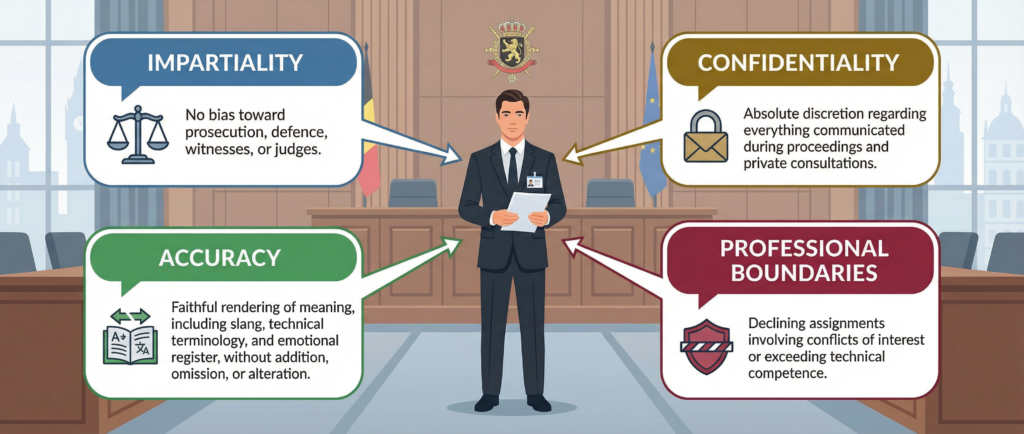
Sworn court interpreting in Belgium functions as a neutral linguistic bridge, not an advocate or assistant to any party.
His responsibilities require:
Casual bilingualism lacks the precision required for legal contexts (specialised vocabulary, procedural knowledge, and ethical training).
Learn why bilingual people cannot replace professional interpreters in court settings.
Unqualified interpreters risk creating appeal grounds based on procedural defects.
Appointment procedures and practical protocols
Criminal case appointments
Magistrates, prosecutors (procureurs du Roi), or federal police appoint interpreters directly from the National Register.
Defendants may request assistance immediately upon language barrier identification; during custody, interrogation, or hearing.
Interpreters typically work consecutively in Belgian courtrooms, though simultaneous equipment is available for complex multi-party proceedings.
Civil and commercial case sourcing
Parties must independently secure interpreters for pre-trial consultations, depositions, notary appointments (real estate transactions under acte authentique), and arbitration.
Brussels commercial cases frequently require interpreters experienced with ICC Rules or UNCITRAL procedures. Business interpreting services ensure accurate communication during high-stakes commercial litigation.
Booking (minimum 72 hours) is essential for rare language pairs or specialised domains like patent litigation.
Verification and quality assurance
Always verify National Register status via the SPF Justice online portal before engagement.
Reputable agencies provide the interpreter’s registration number, judicial district of swearing, and language combinations.
For urgent police interviews or custody situations, confirm the provider maintains on-call National Register professionals compliant with Article 78 of the Code of Criminal Procedure.
Cost structure and legal aid provisions
| Scenario | Cost Responsibility | Key Notes |
|---|---|---|
| Criminal Proceedings | State-funded without exception. Interpreters invoice SPF Justice directly according to standardized fee schedules based on session duration and language rarity. | Ensures equal access to interpretation regardless of the defendant’s financial situation. |
| Civil & Commercial Litigation | Typically follows the “loser pays” principle or private agreements between the parties involved. | Rates vary depending on language rarity, subject matter complexity, and session duration. Translation or interpretation errors can lead to costly procedural consequences. |
| Legal Aid Eligibility | Individuals eligible for legal aid (aide juridique / juridische bijstand) may receive state-funded interpreter services under specific conditions. | Eligibility depends on income thresholds and case type, with application support provided by legal aid offices in each judicial district. |
| Private & Commercial Matters | Costs are privately funded according to transparent rate structures agreed upon before engagement. | Requesting a detailed quote in advance helps avoid unexpected expenses and ensures clarity on pricing and service scope. |
Language demand patterns across judicial districts
National language combinations
Dutch-French dominates Brussels proceedings due to bilingual status.
Dutch-German demand centres on Liège judicial district cases involving the German-speaking Community.
French-German combinations arise in Wallonia’s eastern provinces.
International language requirements
Beyond national languages, Belgian courts handle significant caseloads requiring:
- English: commercial arbitration, EU-related litigation, and international business disputes.
- Arabic: immigration, asylum, and family reunification matters.
- Romanian and Polish: employment disputes and criminal cases involving EU mobile workers.
- Turkish: family law and criminal proceedings.
- Spanish: commercial transactions and consular matters.
Brussels courts handle the most diverse requirements due to EU institutions and multinational corporate presence.
For immediate assistance with upcoming legal proceedings, contact a specialist language service provider at +32 485 85 30 89 or hello@betranslated.be
Frequently Asked Questions
Can family members interpret in Belgian courts?
No. Belgian courts prohibit relatives or friends from providing official interpreting services.
This restriction ensures impartiality and accuracy during proceedings.
Non-professionals lack the required legal vocabulary and ethical training. Using unqualified interpreters creates grounds for procedural appeals.
What happens if I cannot understand the appointed interpreter?
Inform your lawyer or presiding judge immediately. Competent interpreting constitutes a legal right under Article 6 ECHR.
Courts may appoint a replacement interpreter from the National Register. Accepting inadequate services compromises your ability to present evidence effectively.
How can I verify an interpreter’s National Register status?
The SPF Justice maintains an official online verification database. Professional agencies provide registration numbers upon request.
Always confirm National Register inclusion before court appearances. Unregistered interpreters cannot produce legally valid interpretations.
Which languages face the highest demand in Belgian courts?
National language combinations (Dutch-French, French-German) remain consistently required.
- English dominates commercial arbitration and EU institution litigation in Brussels.
- Arabic features prominently in asylum and immigration proceedings.
- Romanian, Polish, and Turkish appear frequently in employment and criminal cases.
- Spanish demand grows with international commercial transactions.
- Brussels courts handle the most diverse language requirements nationally.