Why choosing between bilingual staff and professional interpreters matters for your Belgian business
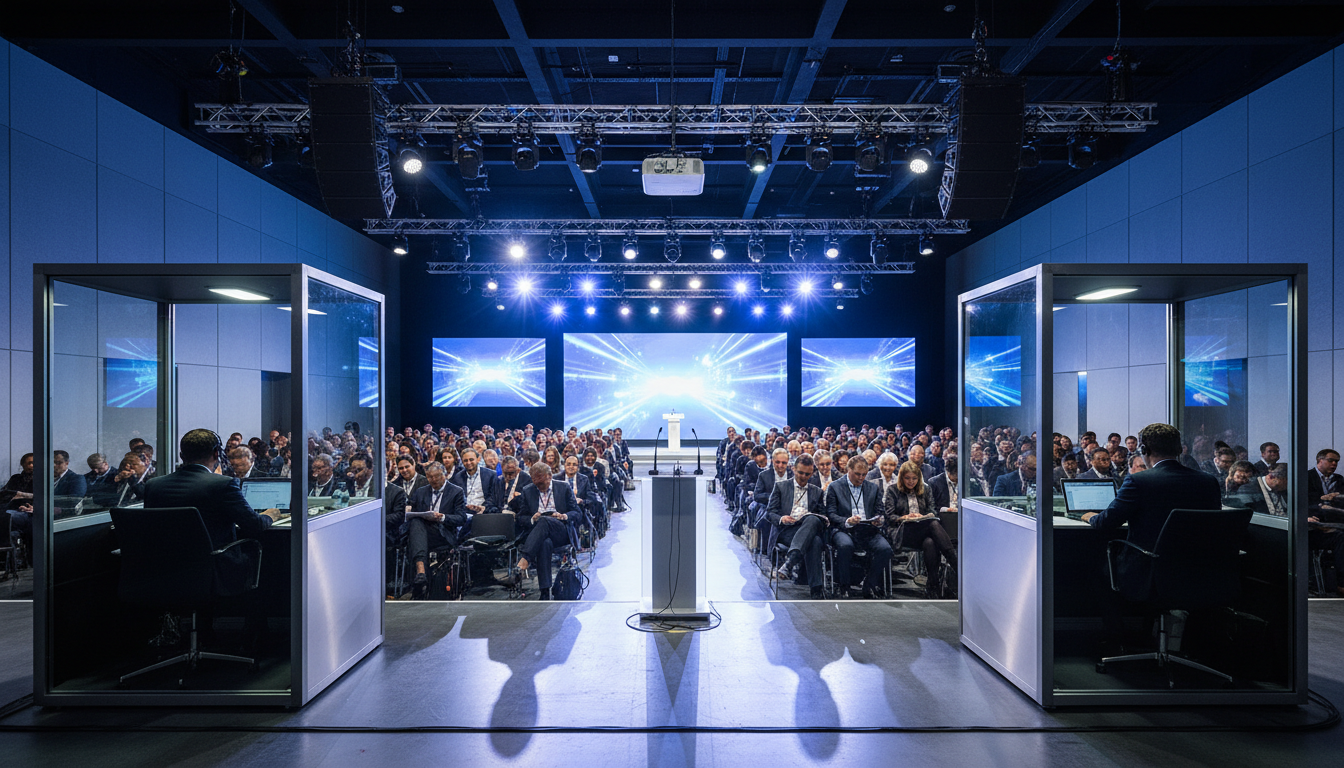
Belgium’s business world thrives on language.
With Dutch, French, German, and English used daily across boardrooms, clinics, courts, and factories, clear communication isn’t just helpful, it’s essential.
Yet many companies still rely on bilingual employees to interpret during meetings, negotiations, or client calls.
It seems practical, even cost-effective. But this shortcut can lead to serious misunderstandings, legal exposure, and damaged trust.
The truth is simple: speaking two languages does not make someone a qualified interpreter.
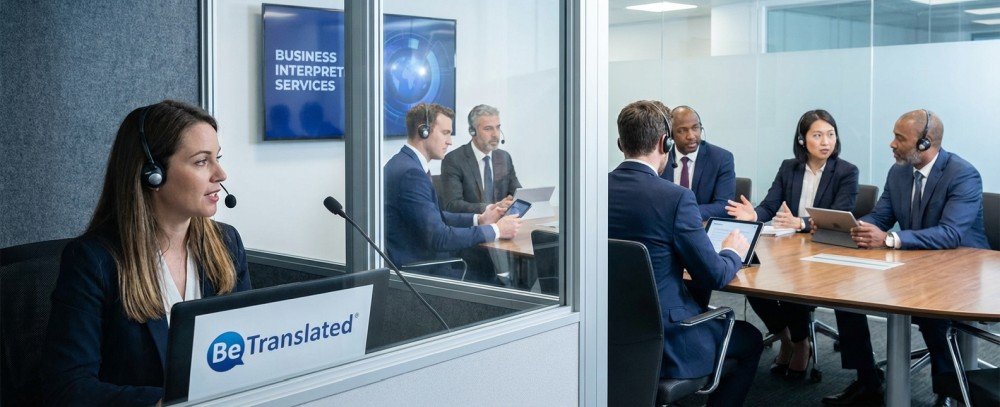
Professional interpreters bring trained skills, ethical standards, and subject-matter expertise that internal staff simply cannot match—even with the best intentions.
Get your free quote in under 2 minutes
Why bilingualism does not equal interpreting competence
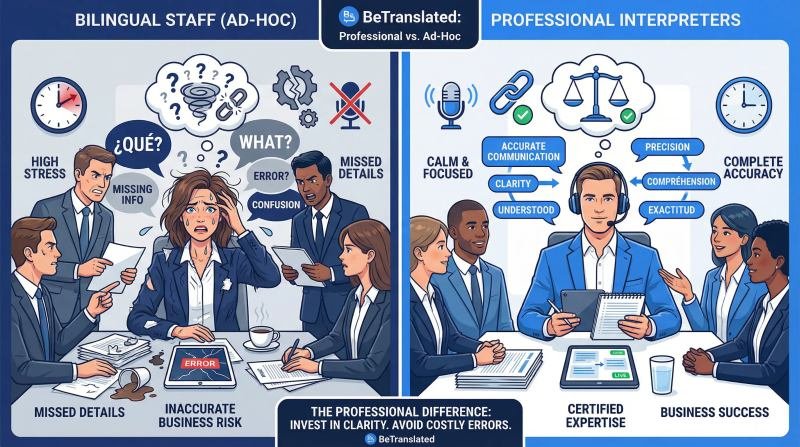
Being fluent in two languages is a valuable skill, but interpreting is a distinct profession. It requires split-second processing, memory techniques, and the ability to convey tone, nuance, and technical detail without distortion.
A bilingual employee might understand a conversation, but under pressure, they often summarise, skip details, or guess—especially during long or complex discussions. This isn’t negligence; it’s cognitive overload.
Professional interpreters, by contrast, are trained to handle exactly these situations. Many hold master’s degrees in conference interpreting and specialise in fields like law, healthcare, or engineering.
Discover the difference between simultaneous and consecutive interpreting
Real consequences of informal interpretation
| Scenario | Risk with bilingual staff | Solution with professional interpreter |
|---|---|---|
| Medical consultation in Liège | Miscommunication of symptoms or dosage | Accurate, ethically bound relay of clinical information |
| HR disciplinary meeting in Ghent | Omission of key details due to stress or bias | Full, impartial rendering of all statements |
| Notarial deed signing in Brussels | Legal invalidity due to misinterpreted clauses | Sworn interpreter (traducteur-interprète juré) ensures validity |
| International product launch in Antwerp | Brand damage from mistranslated messaging | Culturally adapted, industry-specific interpretation |
Ensure your healthcare communications meet legal standards
The ethical imperative: impartiality vs. dual loyalty
Professional interpreters follow a strict code of ethics. They are bound by confidentiality, neutrality, and accuracy. Their role is to transmit every word—without filtering, softening, or omitting—even if the message is uncomfortable.
Employees, however well-meaning, cannot be truly neutral. They work for your company. They may worry about team dynamics, management reactions, or their own position. This “dual loyalty” creates unavoidable bias.
In legal settings, this isn’t just risky, it’s disqualifying. Belgian courts and notaries require sworn interpreters (interprètes assermentés) for official proceedings. Using a colleague could invalidate contracts, depositions, or compliance documentation.
Speak to our legal interpreting specialists today
Legal and financial exposure: the true cost of “free” interpretation
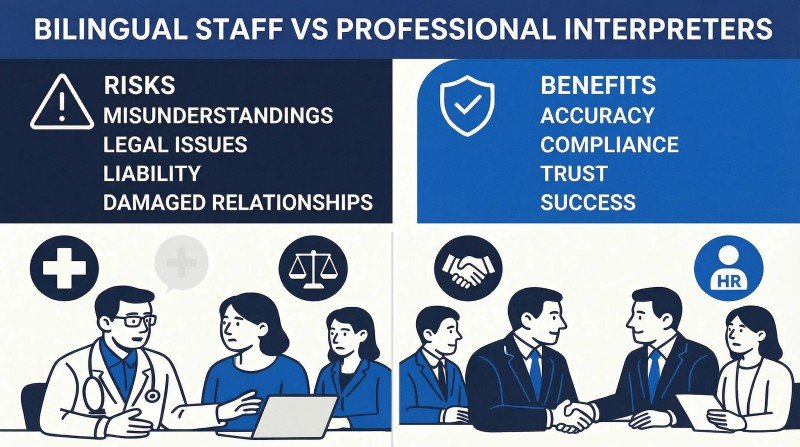
Using a bilingual colleague may seem like a way to save money, but the hidden costs add up quickly.
A misunderstood clause in an employment contract can trigger a labour tribunal case. A misheard medical instruction can lead to patient harm and liability claims. A garbled response during a press Q&A can go viral for the wrong reasons.
These aren’t hypotheticals. We’ve seen businesses lose contracts, face regulatory fines, and suffer reputational damage—all because they skipped professional interpretation to “save time.”
In reality, the fee for a qualified interpreter is a fraction of the potential fallout. It’s not an expense; it’s insurance.
Protect your organisation with vetted interpreters
When to use bilingual staff vs. professional interpreters: a clear policy framework
Smart organisations don’t reject internal language skills—they manage them wisely. Here’s how to draw the line.
Use bilingual staff for low-risk, informal interactions
- Welcoming international visitors at reception
- Giving office tours in Namur, Leuven, or Charleroi
- Casual conversations during team lunches or networking events
These moments build a multilingual culture without exposing your business to risk. Consider recognising these contributions formally—perhaps with a small stipend or internal recognition.
Always hire a professional interpreter for high-stakes situations
- Court appearances, police interviews, or notary appointments
- HR investigations, terminations, or collective bargaining
- Medical consultations, mental health assessments, or informed consent
- Technical training on machinery, software, or safety protocols
- Investor pitches, EU stakeholder meetings, or media events
Download our event interpreter checklist for flawless multilingual meetings
Quick decision checklist
Ask yourself: would a mistake here cause legal, financial, or safety consequences? If yes, do not use an employee. Also consider:
- Is the content confidential?
- Is there a power imbalance (e.g., manager vs. employee)?
- Does the topic involve specialised terminology?
- Will the session last more than 30 minutes?
Fatigue drastically reduces accuracy—even for fluent speakers. Professionals rotate regularly to maintain precision.
Get a custom language policy consultation for your team
Why BeTranslated is trusted by Belgium’s leading organisations
We’re a Belgian-based language partner with deep local roots and global standards. Our interpreters are native speakers of Dutch, French, German, or English—and many hold sworn status for legal and governmental use.
We specialise in high-risk sectors:
- Legal and judicial interpreting (including sworn services)
- Healthcare communication compliant with patient rights laws
- Technical and industrial interpretation for manufacturing and logistics
- EU-facing meetings in Brussels with protocol-aware linguists
Our clients report 98.7% satisfaction on accuracy and professionalism. More importantly, they sleep soundly knowing their communications won’t backfire.
Join 500+ Belgian businesses that trust BeTranslated
Frequently asked questions
Isn’t it more convenient to just grab a bilingual colleague?
It might feel faster, but errors create delays later. Misunderstandings lead to repeat meetings, confusion, and lost productivity. A professional gets it right the first time—and doesn’t pull your staff away from their actual job.
What kind of training do professional interpreters have?
Most hold a Master’s degree in Conference Interpreting. They train in simultaneous and consecutive techniques, terminology management, and ethics. Many of our interpreters are sworn by Belgian courts, meaning they’re legally authorised for official use.
Our employee is happy to help interpret. Why is that a problem?
Willingness doesn’t equal capability. Interpreting is mentally exhausting. Professionals switch every 20–30 minutes to stay sharp. An untrained employee may unknowingly introduce errors that expose your company to liability or even personal blame.
How can we create a language access policy for our organisation?
Start by mapping your high-risk touchpoints: HR, legal, customer service, or healthcare. Then define when only a professional interpreter is allowed. We offer free consultations to help you draft a compliant, practical policy tailored to your sector.
Schedule your free 15-minute strategy call today
Contact BeTranslated
- Phone: +32 485 85 30 89
- Email: hello@betranslated.be
- Web: www.betranslated.be/en
Follow us for multilingual insights:
Instagram | X | LinkedIn | Facebook | YouTube